In April, the Financial Times — drawing on satellite imagery from SynMax and permit data from IIR Energy — reported that nearly 40% of US data center projects scheduled for completion in 2026 will miss their deadlines by at least three months. The cited causes are familiar to anyone running a hyperscale program: chronic shortages of labor, power, and equipment, and a permitting process that has not kept up with demand.
Most of those causes sit outside the owner's fenceline. PJM Interconnection's data, presented in January, shows AI infrastructure projects that came online in 2025 averaged more than seven years from inception to energization. Substation transformer lead times have moved from roughly 140 weeks in 2023 to more than 160 weeks in 2026. None of that is solvable on a construction site.
Inside the fence, however, the calculus is different. Modular construction has compressed the build phase dramatically — from roughly two years to about thirty weeks for some hyperscale templates, according to operators quoted by Bisnow. What that compression does, almost mechanically, is push the bottleneck downstream. The field work finishes faster. The documentation pipeline that has to keep up with it has not been compressed at all.
At a reported cost of delay near $14 million per day at hyperscale, the last 90 days of a project — between substantial completion and operational acceptance — is the period most worth understanding. It is also the period the owner mostly controls.
The real bottleneck is outside the fence
We are not going to pretend AI review of vendor documents will get a 138 kV transformer to site faster. It will not. PJM's own milestone data, reported in January, attributes 29% of project schedule changes to permitting, 28% to a catch-all of land and EPC procurement issues, and 23% to supply chain. The category an owner's engineering team can actually accelerate sits inside the remaining 20%, in the construction-and-commissioning slice. That is the slice this post is about.
The honest pitch is narrow on purpose. Of the things an owner controls in the last stretch of a build, documentation review is increasingly the largest. At a hyperscale campus, the equipment is engineered specifically for the owner, the standards stack is long, the vendor count is high, and the consequences of an undetected gap compound through commissioning into operations.
What the owner still owns
Inside a hyperscaler or colo development organization, the documentation surface is wider than most outsiders assume. There are the obvious artifacts: vendor datasheets, factory acceptance test records, inspection and test plans, installation procedures, Level 3 through Level 5 commissioning scripts and logs, exception lists, certificates, as-builts, O&M manuals. Behind those sit the cross-cutting artifacts that determine whether the building can be operated: the asset register, the BMS point list, the relay coordination study, the closeout checklist tied to the owner's commissioning standard.
None of these are unfamiliar. Most owners already manage them in Aconex, Procore, BIM 360, or some combination. Storage is not the problem. The problem is what happens between “uploaded” and “accepted.” That step — reading the document against the standards, the project specs, the prior comments, and the owner's checklist; deciding what it proves; deciding what happens next — has stayed stubbornly manual while every other part of the build has industrialized.
Why modular construction makes it worse
The push to modular has solved a labor problem and created a documentation one. When a switchgear lineup or a chiller skid arrives at site as a factory-built, factory-tested module, the bulk of its evidence is generated off-site, by a vendor or an OEM, in a jurisdiction and on a schedule the project does not fully control. The owner inherits a package. The owner's commissioning authority must then accept that package against the project's specifications, the OEM's warranty language, and the owner's commissioning standard.
Whether the package is accepted depends almost entirely on whether the evidence inside it is complete, current, and traceable. A factory test record with the right numbers but the wrong asset tag is a problem. A commissioning sequence that matches the OEM's defaults but not the project's setpoints is a problem. A revision that lags one number behind the latest spec is a problem. These are the kinds of issues that take an hour to fix and a week to discover when the volume is high enough.
What actually goes wrong
The patterns are not exotic. They are the same patterns the Construction Industry Institute and a generation of EPC veterans have catalogued for years. ASCC, summarizing Navigant research across 1,362 projects, reports an average of 800 RFIs per project at roughly $1,080 each — about $860,000 and 6,000 hours of engineering time spent on RFI traffic alone. A 2016 ASCE study found only about a fifth of submittals were approved as submitted, and more than a third required a complete revision.
At a hyperscale campus those ratios cash out in days. An owner's engineering team operating against the clock makes specific, repeatable trade-offs: it accepts packages with open exceptions and tries to close them later; it relies on vendor self-certification where it would otherwise verify; it pushes O&M manual review past energization and into the first months of operations. None of those trade-offs is wrong on a given project. All of them get more expensive as a portfolio scales.
The honest pitch for AI
The job of AI in this workflow is narrow and specific. It is not to replace the owner's engineer or the commissioning authority — they keep the accountability, and that is the only way the audit trail survives. The job is to prepare the review so the human can make the decision faster, with the evidence already in front of them and the findings already anchored to the page.
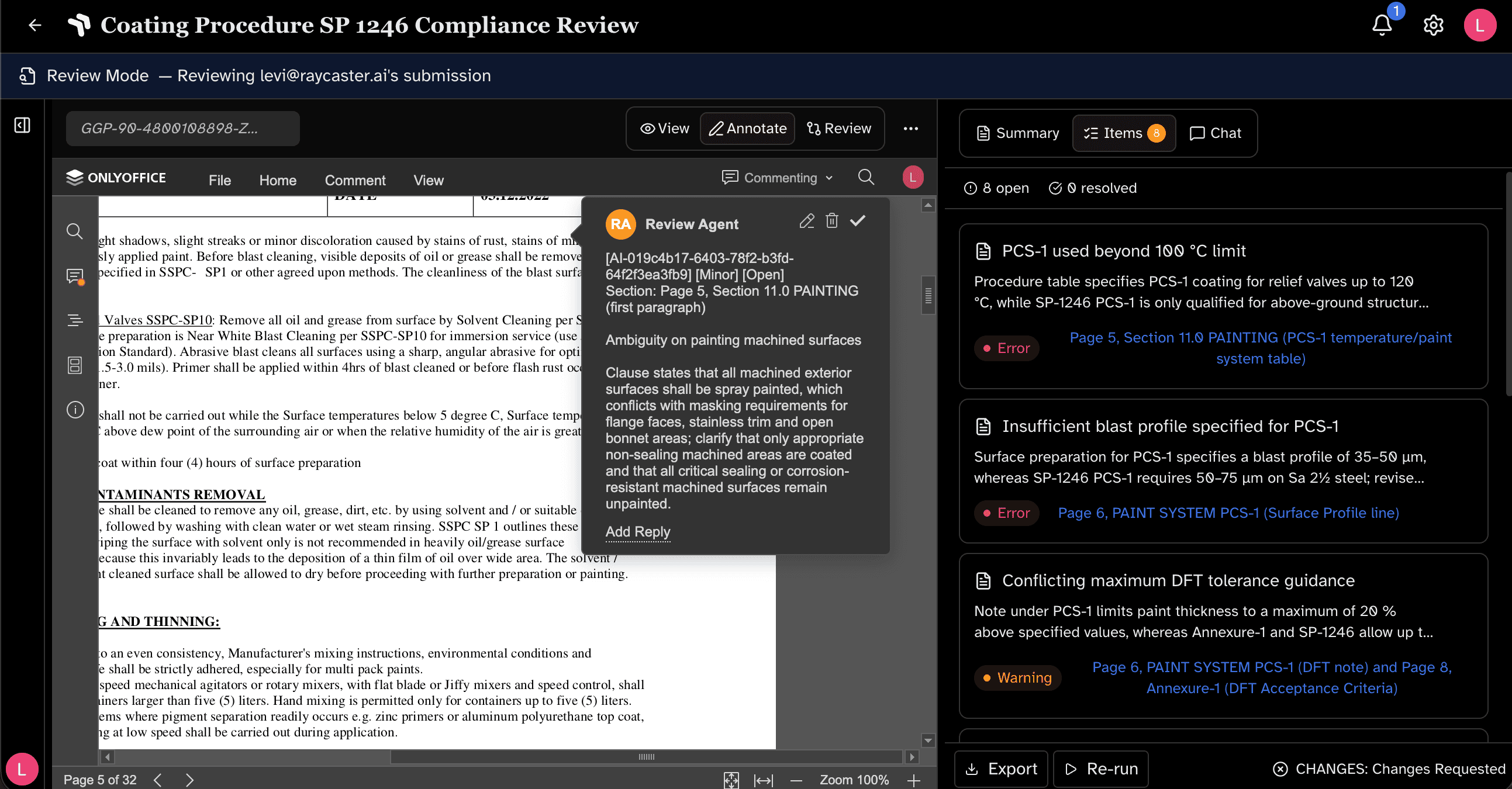
That means a system that maps each document to the correct standards and project requirements; finds the missing clauses, outdated references, conflicting values, and cross-reference errors a tired reviewer would catch in the morning; cites the page, the clause, the cell behind every finding; places comments directly on the document the vendor will receive; and supports the disposition that determines whether work can move.
This is the wedge Raycaster works on. Map the standards once. Hand Raycaster the package. It returns cited findings with severity, location, and a suggested comment placed where the vendor will see it. The commissioning manager and the owner's engineer still own the call.
Data center delivery used to be a story about concrete, copper, and CAPEX. Inside the fence, it is quietly becoming a story about evidence — and the teams that win the next decade of capacity will not be the ones with the most folders. They will be the ones that turn documents into decisions before the schedule needs them to.