Closeout has a reputation as the dull last act of a construction project. The build phase has the photographs and the milestones. Operations has the uptime dashboard and the SLA. The handover binder, by tradition, sits between them: thick, well-tabbed, and largely ignored until someone needs it.
For a data center the framing is wrong, and the EDMS vendor that hosts most of this work says so itself. Aconex's own Smart Manual guidance states the dependency directly: “Handover manual quality is directly affected by the quality of asset information in the drawing / document and document register.” The binder is a symptom. The register is the system.
What Aconex itself says
Aconex's public handover documentation is unusually candid about what a usable turnover record requires. Every document in the register must carry document number, revision, title, type, status, discipline, area or zone, asset reference, and revision date. Every asset on site must appear on a Master Asset Register — an Excel-format equipment schedule submitted by the contracted services and suppliers and combined by the owner. Placeholder document numbers are reserved against that register so the contractor or vendor can transmit the actual file back into the right slot.
In other words, the handover model that Aconex itself documents is not a folder model. It is a register model. The PDFs hang off the register; the register is what facilities inherits.
The dependency works in only one direction. A perfect PDF with the wrong asset reference disappears in the register. A commissioning record with an ambiguous status creates retesting later — or worse, an unresolved risk the operations team finds on its first night. A manual without the right equipment tag slows maintenance for the life of the building.
The 3 a.m. test
The test of a turnover package is not whether it looks complete in the EDMS. The test is what happens at 3 a.m. on the first night the facility runs. A breaker alarms in a switchboard on the second floor. The on-call technician opens the asset register, types the tag from the alarm, and gets back — what?
In a healthy handover, he gets back the right manual, the relay coordination study tied to the right revision, the factory test record, the closeout certificate, the OEM's warranty terms, and the commissioning log that proves the protective settings were applied. In an unhealthy one, he gets back three files with three different naming conventions, the latest revision of one and an older revision of another, and an O&M manual that uses the vendor's internal designation rather than the owner's project tag.
Nothing is wrong with the equipment. The construction was fine. The documentation was uploaded on time. The register did not converge — and the technician spends an hour at 3 a.m. doing what no contract intended him to do, which is reconstruct the project's naming decisions from three sources at once.
Complete folder, incomplete evidence
From a distance, a turnover package can look complete. The folder exists. The file counts hit. The required document types appear to be present. Closer in, the questions are more precise:
- Does every required asset have the right O&M document?
- Do document numbers, titles, and metadata fields follow the project convention defined in the EDMS?
- Are revision and status fields current?
- Do equipment tags match the Master Asset Register?
- Are commissioning exceptions closed, or clearly carried forward?
- Are test records tied to the right system and location?
- Are vendor documents still referencing superseded specs?
- Are required certificates present and traceable?
If the answer to any of those is “unclear,” the package is not yet ready for turnover. It just looks ready.
The register is the product
For a hyperscaler or colo operator, the register is what eventually flows into Maximo, Nuvolo, or whatever CMMS the facilities team runs. That handoff is where construction and operations actually meet, and it is the handoff that determines whether the facility's warranty terms can be enforced, whether preventive maintenance can be scheduled against the right asset, and whether a future incident investigation has the evidence it needs.
When that handoff fails, it usually fails quietly. The project does not get blamed at handover — there are too many other handoffs that night, and operations is still ramping. The pain shows up six months later in a backlog of work orders against assets the CMMS does not recognize, or in a maintenance contract dispute because the warranty registration carried the wrong tag.
What AI should do for closeout
Most AI document workflows are file-centric: upload a PDF, ask a question, get a summary. Turnover is package-centric. The review has to reason across files and across the register itself.
That means comparing the asset list against the submitted documents and flagging the equipment with no O&M manual. Identifying the systems whose commissioning record is missing a discipline sign-off. Catching the revision that is one number behind the latest spec. Surfacing exceptions that were opened during commissioning but never explicitly closed. Producing comments the GC or vendor can act on, instead of a long narrative the owner's rep has to translate.
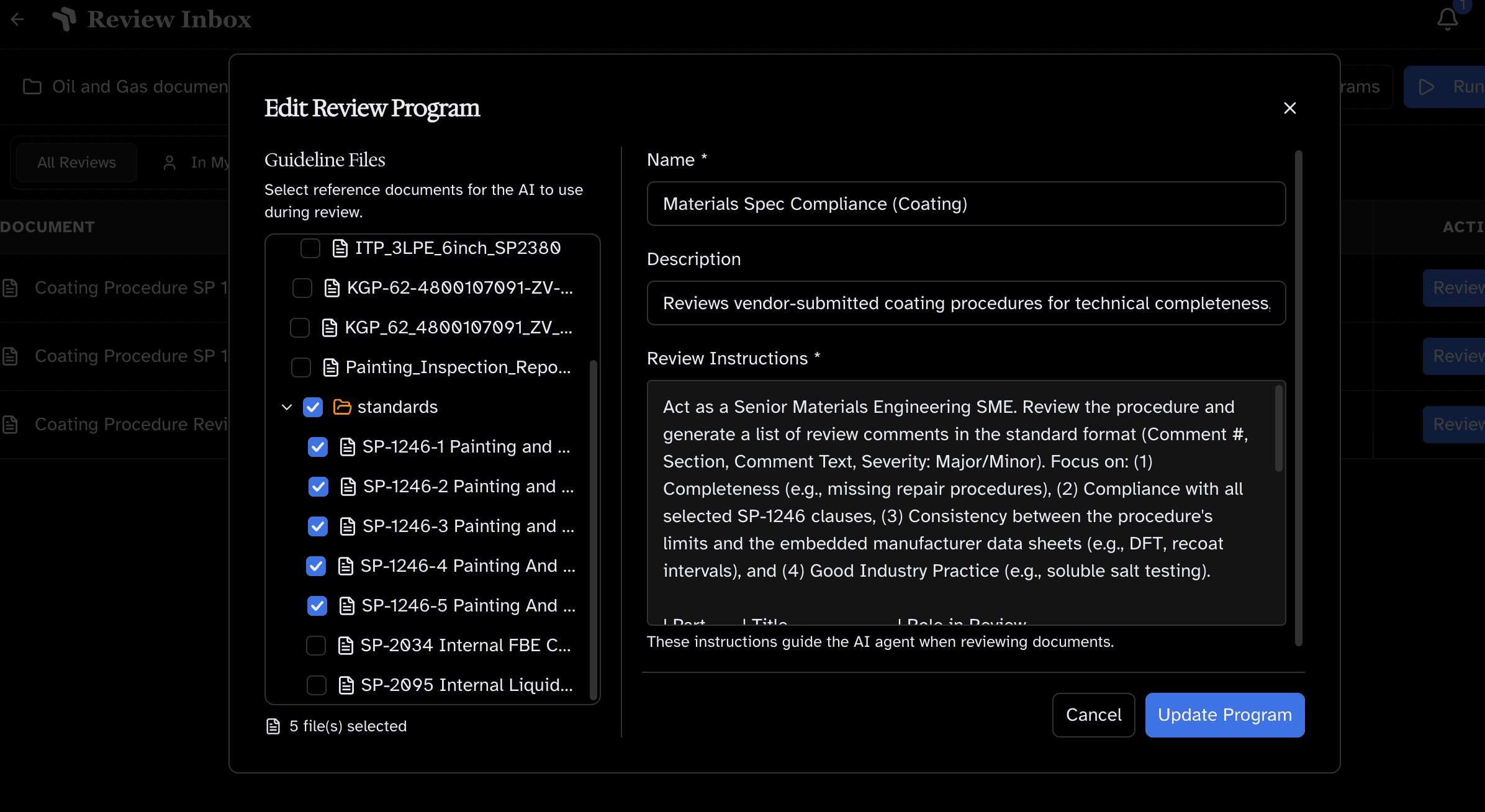
Raycaster turns turnover review into a repeatable workflow: map the required documents, the metadata fields, the owner's standards, and the asset register once; review each package against those requirements, file by file and across files; create cited findings for missing evidence, inconsistent references, and unresolved issues; place comments directly on the documents the vendor or GC will see; and let the human reviewer approve, approve with comments, revise, or reject — preserving the trail.
A data center operator does not want a handover binder. They want confidence that the facility they are about to run is documented well enough to run.